

The biggest challenges in remote communications include limited infrastructure, harsh environmental conditions, difficult terrain, rapid deployment requirements and equipment reliability. These challenges can be overcome by using specialist communication systems, deployable masts, high-performance RF equipment and preventative maintenance programmes designed for demanding operational environments.
Why are remote communications more challenging?
Unlike urban environments, remote locations often lack fixed communication networks, reliable power supplies and established infrastructure. Teams may operate in isolated areas, mountainous terrain, offshore locations or regions affected by severe weather, where maintaining continuous connectivity requires carefully engineered communication systems.
Successful remote communications depend on selecting equipment that is reliable, adaptable and designed to perform consistently in challenging conditions.
1. Limited communication infrastructure
One of the biggest challenges in remote communications is the absence of fixed communication networks. Mobile coverage may be unreliable or unavailable, while existing infrastructure may not provide sufficient coverage for operational requirements.
How to overcome it
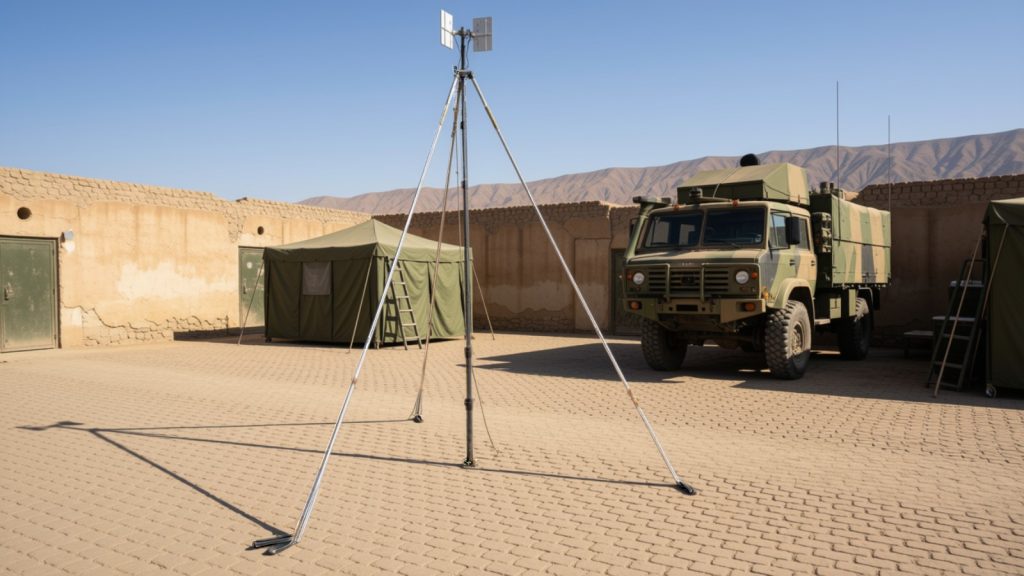
Deployable communication systems, including specialist telescopic masts, RF communication equipment and antenna systems, allow organisations to establish reliable communication networks wherever they are needed.
Portable communication infrastructure reduces reliance on existing networks and provides greater operational flexibility for temporary deployments, disaster recovery, military operations and remote engineering projects.
2. Harsh environmental conditions
Remote communication systems are frequently exposed to challenging operating environments, including:
• High winds
• Heavy rainfall
• Snow and ice
• Extreme temperatures
• Dust and sand
• Coastal salt exposure
• High humidity
These conditions can affect both mechanical components and communication performance if equipment is not designed for the environment.
How to overcome it
Choose communication equipment engineered specifically for demanding environments. Look for features including:
• Corrosion-resistant materials
• Robust mechanical construction
• UV-resistant finishes
• Environmental protection
• Proven long-term durability
Well-engineered equipment requires less maintenance and delivers greater operational reliability throughout its service life.
3. Difficult terrain and signal obstruction
Mountains, forests, valleys and dense vegetation can obstruct radio signals and reduce communication range. Maintaining line-of-sight between communication equipment is often essential for achieving reliable RF performance.
How to overcome it
Elevating antennas using specialist telescopic mast systems significantly improves line-of-sight communications and increases coverage.
Selecting the correct mast height, antenna type and deployment location helps optimise communication performance while maintaining structural stability.
4. Rapid deployment requirements
Many remote operations require communication systems to be operational within minutes rather than hours.
This is particularly important during:
• Defence deployments
• Emergency response
• Disaster recovery
• Temporary command centres
• Critical infrastructure projects
• Field engineering operations
How to overcome it
Portable communication systems designed for rapid deployment enable teams to establish reliable communications quickly.
Lightweight, transportable mast systems with simple deployment mechanisms reduce setup time while maintaining the reliability required for operational use.
5. Equipment reliability and maintenance
Remote locations often make equipment repairs difficult and expensive.
If communication equipment fails, replacement parts, technical support or engineering assistance may not be immediately available, increasing operational downtime.
How to overcome it
Investing in high-quality communication infrastructure and implementing preventative maintenance programmes significantly reduces the risk of unexpected failures.
Selecting equipment supported by long-term servicing, technical expertise and readily available spare parts helps maximise equipment availability throughout its operational life.
6. Integrating multiple communication systems
Many remote operations require several technologies to work together, such as HF, VHF and UHF antennas, microwave links, surveillance cameras, weather sensors and lighting systems. Poor integration can increase deployment time, reduce efficiency and create unnecessary complexity.
How to overcome it
Choosing a communication partner with in-house engineering expertise ensures multiple headloads and communication technologies can be integrated into a single, optimised solution.
Bespoke communication systems designed around operational requirements improve reliability, simplify deployment and provide greater flexibility as mission requirements evolve.
What makes a resilient remote communications system?
Successful remote communication systems are built around several key principles:
• Equipment engineered for demanding environments
• Reliable, high-quality RF communication systems
• Rapid deployment capability
• Specialist telescopic mast systems
• Infrastructure designed around operational requirements
• Preventative maintenance and lifecycle support
• Flexible integration of communication equipment
Considering these factors during system design helps improve operational resilience, minimise downtime and maximise communication reliability.
Supporting reliable communications wherever they’re needed
Reliable remote communications require complete systems engineered to perform consistently in demanding environments.
At SMC Group, we design and manufacture specialist communication solutions that support reliable operations wherever they’re needed. From deployable telescopic masts and RF communication equipment to bespoke integrated systems through SMC Custom, our in-house engineering expertise helps organisations overcome the challenges of operating in remote and demanding environments.
Whether supporting defence, emergency services, telecommunications, transport, utilities or critical infrastructure, our solutions are designed to deliver dependable communications when reliability matters most.
Frequently Asked Questions
What are the biggest challenges in remote communications?
The biggest challenges include limited communication infrastructure, harsh environmental conditions, difficult terrain, rapid deployment requirements, equipment reliability and integrating multiple communication technologies into a dependable system.
How do you maintain communications in remote locations?
Reliable remote communications are achieved by using deployable communication systems, specialist telescopic masts, appropriately specified RF equipment, robust antennas and preventative maintenance programmes designed for the operating environment.
Why are telescopic masts used for remote communications?
Telescopic masts elevate antennas, and other headloads, above surrounding obstacles, improving line-of-sight communications, increasing signal coverage and enabling reliable communications where fixed infrastructure is unavailable.
Which industries rely on remote communication systems?
Remote communication systems are widely used across defence, emergency services, telecommunications, transport, utilities, broadcasting, environmental monitoring, critical infrastructure and disaster recovery operations.
Browse our standard range or download our free SMC Custom Guide here. If you have a project you’d like to discuss, you can request a quote online or email us direct at sales@smcgroupglobal.com